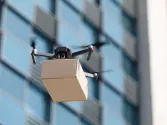
Drone deliveries carve out premium niche in China retail
Companies target speed and convenience instead of replacing traditional couriers.
Chinese retailers are positioning drone deliveries as a premium logistics service for situations where speed matters most, rather than as a replacement for conventional courier networks.
“The primary goal is to have service differentiation that ultimately would lead to a consumer experience,” Sandy Lim, director and lead analyst at S&P Global Inc., told Retail Asia. “The goal is not to compete on price, but on service.”
Lim said drone delivery remains far from profitability because of high operating costs and limited scale.
“We would need about one million drone delivery orders to be at a break-even level,” she said via Zoom. “We're really far away from that,” she added, noting that breakeven may only be achieved in six to eight years.
China's biggest delivery platforms are nevertheless expanding their drone operations as consumers increasingly expect deliveries within 30 minutes or less.
Tianbing Zhang, China consumer industry leader at Deloitte Touche Tohmatsu Certified Public Accountants LLP, said consumers' demand for faster fulfilment is encouraging companies to develop delivery options that bypass traffic congestion and geographic barriers.
He cited Meituan's drone network, which can reduce a “40-minute, 7.8-kilometre ride into a five-minute cross-sea flight.”
Government policy has also supported the industry's development. Zhang said China's “low-altitude economy” has been incorporated into official work reports and backed by several regulatory measures since 2025, encouraging companies to test commercial drone services.
The technology is finding its strongest commercial opportunities in parks, scenic attractions, islands, and other locations where conventional delivery is slower or more expensive.
Food delivery is emerging as one of the most practical applications.
“If you order a bowl of noodles, in 10 minutes you get that bowl of noodles,” Lim said, compared with roughly 20 minutes for a delivery rider.
Meituan has elevated its drone business to CEO-level supervision, reflecting its strategic importance, Zhang said.
Despite operating in about 12 cities, Lim said more than 70% of Meituan's drone deliveries still take place in Shenzhen.
The company operates about 65 to 70 routes and more than 500 take-off and landing sites, with cumulative commercial orders exceeding 900,000. Even so, drone deliveries account for only about 0.01% of its total delivery volume.
Other logistics companies are also expanding.
JD Logistics, Inc. operates nearly 50 regular test routes across cities including Shanghai, Shenzhen, Chengdu, and Xi'an. Taobao Flash Delivery has launched drone routes in Guangzhou and Zhoushan for cross-river and island deliveries.
SF Express has established more than 600 drone routes across multiple cities, particularly in Hainan and Hong Kong, Zhang said.
Even as deployments expand, both analysts said technical and regulatory hurdles will keep drone delivery a specialised service.
Most deliveries still require customers to collect orders from designated landing points instead of receiving them at their doorstep. Payloads are typically limited to about 2.5 kilos, restricting drones to lightweight and time-sensitive goods.
Regulations also vary by city. Lim noted that drones are prohibited in parts of Beijing because of government and military facilities, whilst operators must secure approval for individual routes.
Zhang also cited fragmented regulations, technology limitations, infrastructure gaps, operating costs, and public acceptance as barriers to wider adoption.
He expects rural communities, mountainous areas, and islands to benefit earlier because drones can reduce transport costs where roads are less efficient.
JD Logistics, for example, used drones to transport more than 100 boxes of cherries in Sichuan in two hours, whilst deliveries in Hubei improved logistics efficiency by 60% and cut costs by 20%, he said.
Neither analyst expects drones to dominate China's delivery market.
“It will not be mainstream,” Lim said, estimating drones could eventually account for about 10% of deliveries.




















 Read Here
 Advertise
 Sign Up